July 27, 2007
Day 28
Prayers and Pizza in Southwark
Sorry for the slightly irreverent heading, but it does describe our activities last evening.
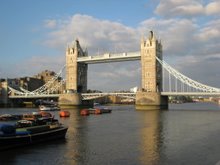
First we attended a brief service at the Southwark Cathedral, home of the Anglican Diocese in this area. The Cathedral lies on the South Bank of the River Thames close to London Bridge on a site occupied by a Church for over one thousand years. The main structure of today's church was built between 1220 and 1420. http://www.southwark.anglican.org/cathedral/
Today this lovely structure is crammed in, between office buildings, restaurants, pub, cobbled streets and even the initial ramp of the London Bridge. I would describe the ground-level, historic, structure (although best seen from the sidewalk of the bridge, some 20-ft above) as “hunkered-down” in the midst of all this mélange. However the upper levels, including the spires, windows and bell tower, reach into the sky, like the blooms on a flower searching for light and air!
I’m not much of an architect or cathedral expert, but found the inside of the cathedral to be altogether lovely and expansive—clearly the rival of much more celebrated churches we have seen. It only opens for church services and tours with appointment; so we took advantage of the service of readings to gain entrance.
I don’t think I can improve on the physical description of the web link above, but the service was simple, informal and quite calming. Only about a half-dozen people were present; so the reader invited us up into the choir area, if we wanted. We remained in the sanctuary hall with the beautiful stained-glass window before us and the fan-styled, stone roof high above.
The reader told the story of King Saul, when Samuel announced that he would loose his kingdom to another because he made a burned offering to keep the people happy. What a commentary on our world today! Also at the end, during the Lord’s Prayer, they used the phrase, “forgive us our sins as we forgive those who sin against us.” What a beautiful and difficult way to say it.
At the close of the service, I lit a candle for my brother and for a friend who helped him. In the presence of this beautiful, peaceful cathedral, surrounded by so much anxiety and noise, it seemed like the thing to do.
By the way, the Londoners don’t say “South-wark” the way it is spelled. The best I can describe it is “sudth-erk” with the emphasis on the “sudth.” Go figure!
As far as the pizza part of my story is concerned, we tried a local pizza restaurant in the shadow of the cathedral. We had a great salad, some wine and shared a pizza (NOT NY style), but something crisp, aromatic and quite tasty.
##
Saturday, 28 July 2007

Friday, 27 July 2007
Fulbright Project and "Wicked" in London!
27 July 2007
Day 28
Fulbright Project
The “project” is beginning to come together (at last!). Jeff French, the NSMC director and I discussed it again yesterday and decided that developing a draft framework of an American National Strategy for Social Marketing in Public Health would be a useful exercise both for the England (mainly because it is based, in part, on my observations of the NSMC and the development of social marketing here), and possibly for the US. I am not aware of a US national strategy, or of an ongoing discussion regarding a plan for its development. According to a few colleagues, there have been discussions in the past, but they were abandoned without resolution.
Admittedly, it is presumptuous that I should undertake such a task—certainly alone, perhaps at all. I am not a “patron saint” in the social marketing field, by any means. But I believe that social marketing can and does make an important contribution to public health (and to other areas of “public good”). Also I believe that we need to realign the disconnects between public policy, funding, research, training, professions and practice (including partnerships with other sectors) if we are to realize the full potential of social marketing in the US. It’s a big challenge, but if I can only revive the discussion and help to give it momentum, it may be a worthwhile endeavour.
The contrast between the US and England is becoming clearer to me after a few weeks of observation. England created a policy umbrella at the highest levels of government—including the Department of Health (DH), the NCC/NSMC and several other governmental agencies. This appears to result from a large amount of luck (being in the right place at the right time with the right people) and taking advantage of opportunities created through hard work and vision. The key players plan to work out along the ribs of the umbrella, as it were, to bring in other policy partners and expand the overall field. Also, the NSMC identified 10 demonstration sites (under its contract with the DH) and works with them to train staff and provide technical assistance. These activities, along with an incredible number of superb supportive documents, meetings, plans and other excellent work by a small core staff, support the policy-level infrastructure with the potential for stimulating an ever-wider penetration of social marketing into the national, regional and local levels.
According to one report, there are number of academic centers involved in social marketing teaching and research in the UK, but only one has a robust, long term program. Otherwise, teaching and research in social marketing is described as being “relegated to modules within other degree programs.” Obviously, the success of social marketing at the policy level and its intended extension into practice raises the question of “who is going to train social marketing professionals in the future?” So although the English model has real strengths, there are also clear challenges.
The US, on the other hand, seems to approach social marketing from a more combined academic and pragmatic point of view—as counterintuitive as that may sound. There are several key US academic centers offering social marketing training and research, (although I am not sure there is a current and systematic listing of these programs). The RI Department of Health has hired several regionally-trained public health professionals over the past few years with real expertise in social marketing. Many more of us got our training from the USF National Conference on Social Marketing in Public Health, or from the associated field schools and related activities. In addition, the Robert Wood Johnson Foundation (RWJF) funded the Turning Point Initiative. Started in 1997, Turning Point created a network of 23 state partners and five National Excellence Collaboratives to transform and strengthen the public health system in the United States. Although the program has closed, many of its products are archived on the turning point website http://www.turningpointprogram.org/ and are available for use. Obviously, the participating states and others still benefit from involvement in this excellent program.
It appears that one could describe the evolution of social marketing in the US as more of a “grass roots” approach rather than a policy approach. In other words, a few key academic centers have produced modest sized classes of students prepared in social marketing practice; some expanded these programs into conferences and special schools. At the same time, an increasing number of state and local health agencies, as well as private, voluntary organizations are using social marketing-based interventions. Unlike England, the US does not have a social-marketing friendly policy (e.g. designated funding and exclusive status as a public health intervention) at the highest levels or a series of documents and plans to promote social marketing throughout the governmental and public/private practice sectors. This may change with the relatively new Coordinating Center for Health Marketing and Communication at CDC. However, as far as I am aware, neither country has policies to fully address the development of social marketing in the academic and professional (competencies, benchmarks, and certification) sectors.
So, once again, my apologies to more knowledgeable colleagues for any errors or misconceptions in this analysis, so far. I hope that you will give me your encouragement, advice and point me in the right direction for more information.
26 July 2007-07-27
Day 27
Wicked Good Time!
Last night Linda and I went to see “Wicked” the rave London musical telling the story behind the two witches in Oz: Glinda, the “good” witch and Elphaba, the “wicked” witch. It was a wonderful production—one of the best I have ever seen! The cast portrayed their characters with energy and style, the voices were wonderful, the choreography thrilling and the sets fantastic. The sets included a backdrop of moveable panels with gigantic gears and levers and other mechanical devices. And the flying monkeys were so believable! They reminded me of the authenticity of the feline characters in Cats; after a while I forgot they were actors!
Day 28
Fulbright Project
The “project” is beginning to come together (at last!). Jeff French, the NSMC director and I discussed it again yesterday and decided that developing a draft framework of an American National Strategy for Social Marketing in Public Health would be a useful exercise both for the England (mainly because it is based, in part, on my observations of the NSMC and the development of social marketing here), and possibly for the US. I am not aware of a US national strategy, or of an ongoing discussion regarding a plan for its development. According to a few colleagues, there have been discussions in the past, but they were abandoned without resolution.
Admittedly, it is presumptuous that I should undertake such a task—certainly alone, perhaps at all. I am not a “patron saint” in the social marketing field, by any means. But I believe that social marketing can and does make an important contribution to public health (and to other areas of “public good”). Also I believe that we need to realign the disconnects between public policy, funding, research, training, professions and practice (including partnerships with other sectors) if we are to realize the full potential of social marketing in the US. It’s a big challenge, but if I can only revive the discussion and help to give it momentum, it may be a worthwhile endeavour.
The contrast between the US and England is becoming clearer to me after a few weeks of observation. England created a policy umbrella at the highest levels of government—including the Department of Health (DH), the NCC/NSMC and several other governmental agencies. This appears to result from a large amount of luck (being in the right place at the right time with the right people) and taking advantage of opportunities created through hard work and vision. The key players plan to work out along the ribs of the umbrella, as it were, to bring in other policy partners and expand the overall field. Also, the NSMC identified 10 demonstration sites (under its contract with the DH) and works with them to train staff and provide technical assistance. These activities, along with an incredible number of superb supportive documents, meetings, plans and other excellent work by a small core staff, support the policy-level infrastructure with the potential for stimulating an ever-wider penetration of social marketing into the national, regional and local levels.
According to one report, there are number of academic centers involved in social marketing teaching and research in the UK, but only one has a robust, long term program. Otherwise, teaching and research in social marketing is described as being “relegated to modules within other degree programs.” Obviously, the success of social marketing at the policy level and its intended extension into practice raises the question of “who is going to train social marketing professionals in the future?” So although the English model has real strengths, there are also clear challenges.
The US, on the other hand, seems to approach social marketing from a more combined academic and pragmatic point of view—as counterintuitive as that may sound. There are several key US academic centers offering social marketing training and research, (although I am not sure there is a current and systematic listing of these programs). The RI Department of Health has hired several regionally-trained public health professionals over the past few years with real expertise in social marketing. Many more of us got our training from the USF National Conference on Social Marketing in Public Health, or from the associated field schools and related activities. In addition, the Robert Wood Johnson Foundation (RWJF) funded the Turning Point Initiative. Started in 1997, Turning Point created a network of 23 state partners and five National Excellence Collaboratives to transform and strengthen the public health system in the United States. Although the program has closed, many of its products are archived on the turning point website http://www.turningpointprogram.org/ and are available for use. Obviously, the participating states and others still benefit from involvement in this excellent program.
It appears that one could describe the evolution of social marketing in the US as more of a “grass roots” approach rather than a policy approach. In other words, a few key academic centers have produced modest sized classes of students prepared in social marketing practice; some expanded these programs into conferences and special schools. At the same time, an increasing number of state and local health agencies, as well as private, voluntary organizations are using social marketing-based interventions. Unlike England, the US does not have a social-marketing friendly policy (e.g. designated funding and exclusive status as a public health intervention) at the highest levels or a series of documents and plans to promote social marketing throughout the governmental and public/private practice sectors. This may change with the relatively new Coordinating Center for Health Marketing and Communication at CDC. However, as far as I am aware, neither country has policies to fully address the development of social marketing in the academic and professional (competencies, benchmarks, and certification) sectors.
So, once again, my apologies to more knowledgeable colleagues for any errors or misconceptions in this analysis, so far. I hope that you will give me your encouragement, advice and point me in the right direction for more information.
26 July 2007-07-27
Day 27
Wicked Good Time!
Last night Linda and I went to see “Wicked” the rave London musical telling the story behind the two witches in Oz: Glinda, the “good” witch and Elphaba, the “wicked” witch. It was a wonderful production—one of the best I have ever seen! The cast portrayed their characters with energy and style, the voices were wonderful, the choreography thrilling and the sets fantastic. The sets included a backdrop of moveable panels with gigantic gears and levers and other mechanical devices. And the flying monkeys were so believable! They reminded me of the authenticity of the feline characters in Cats; after a while I forgot they were actors!
Wednesday, 25 July 2007
Academic meeting and Site Visit
25 July 2007
Day 26
Today I met with Ann Wylie, PhD, Senior Tutor at the KCL Undergraduate Medical School. We enjoyed a long discussion about her efforts to teach health promotion to medical students in each of the 5-years of training. She has some rather innovative methods, in my opinion, of exposing medical students to some of the ecological issues of health and the difficulties and strategies for changing risk behaviors. I don’t believe we have anything like it in the States, although my direct experience with medical education is limited.
What I liked about her approach is that it was a way of helping practicing physicians to be aware of population health promotion and developing support in that sector. We also talked about the possibility of including social marketing in that curriculum as a way of building support for the strategic program into the future. Although I am still struggling to fully understand the structure of government, public health and academic sectors in England, we talked about the position of the Faculty in Public Health (and the Voluntary Register) as well as some of the other organizations involved, such as the Association of Study of Medical Education (ASME), the Association of Medical Education Europe (AMEE) and the Society of Academic Primary Care (SAPC)---about their position on social marketing. I think it’s fair to say, they don’t have one.
Here again, I think there is a valuable opportunity to garner strategic support for social marketing in primary care medicine and medical education. I believe key academic partners are willing to play a role (and seem to have a strong strategic position in the relevant organizations) but would need support from NSMC and other partner organizations. A more informed discussion with her, perhaps a presentation to one or more of the relevant groups, an article in one of the professionals journals (Health Education Journal?) and some other activities would go a long way to making this possibility a reality. I can’t imagine a more powerful, strategic support for social marketing in public health than to have the understanding and support of primary care professionals—especially corps of new physicians (the KCL medical class alone is more than 400 each year!) over the next decade or so.
Also, I plan to take some of these ideas back to Brown with me and talk there about the possibility of including social marketing (along with health promotion in general) in the medical curriculum. (See A. Scott-Samuel and J. Wills in Health Education Journal, 2007:66, 115 for an article: “Health Promotion in England: sleeping beauty or corpse?”
Metropolitan PCT site visit (Hamlet Towers):
At an earlier meeting, one of the associate staff at a local PCT offered to give a tour and site visit. Linda joined me and we set off on the tube for the East London area known at Whitechapel. I knew something was radically different when we emerged from the station into a busy street filled with sidewalk merchants and people of every conceivable nationality or ethnicity. There were turbans, sarongs, burkas, shorts, robes etc., etc., reminiscent of a busy street in Cairo or Istanbul—hardly what I expected in London. Our guide explained that 40% of the population in this area is Muslim (from various countries) with white Britishers accounting for another 40%. The remainder comes from all over the world and settles here due to the more reasonable living costs (compared to downtown London). After only a few moments, we passed across the street from the London Mosque which was broadcasting the call to prayers throughout the neighbourhood.
This is also the world of Sherlock Holmes, Jack the Ripper and alas, the start of the Salvation Army (of which my parents were officers). We explored the narrow streets filled with restaurants, shops and artists only to emerge on the edge of the financial district and below a unique building widely known by the nickname "The Gherkin." It is 180 meters (590 ft) tall, making it the second-tallest building in the City of London. I like to think of it as the “lipstick”—but that’s just me.
So we walked through the open markets, back alleys and broad avenues trying to soak up some of the diverse culture of the area. I didn’t directly observe any desperate poverty, but can only imagine some of the issues that exist in the vast expanses of public housing and tenement towers. It was more difficult to imagine trying to promote health in an area with so many different languages and cultures. But our guide persisted in pointing out the richness of the culture and the essential energy of the population crowding the streets. Perhaps this reminds us that while health is certainly one of the most valued things, it is not the only thing that matters…..
##
Day 26
Today I met with Ann Wylie, PhD, Senior Tutor at the KCL Undergraduate Medical School. We enjoyed a long discussion about her efforts to teach health promotion to medical students in each of the 5-years of training. She has some rather innovative methods, in my opinion, of exposing medical students to some of the ecological issues of health and the difficulties and strategies for changing risk behaviors. I don’t believe we have anything like it in the States, although my direct experience with medical education is limited.
What I liked about her approach is that it was a way of helping practicing physicians to be aware of population health promotion and developing support in that sector. We also talked about the possibility of including social marketing in that curriculum as a way of building support for the strategic program into the future. Although I am still struggling to fully understand the structure of government, public health and academic sectors in England, we talked about the position of the Faculty in Public Health (and the Voluntary Register) as well as some of the other organizations involved, such as the Association of Study of Medical Education (ASME), the Association of Medical Education Europe (AMEE) and the Society of Academic Primary Care (SAPC)---about their position on social marketing. I think it’s fair to say, they don’t have one.
Here again, I think there is a valuable opportunity to garner strategic support for social marketing in primary care medicine and medical education. I believe key academic partners are willing to play a role (and seem to have a strong strategic position in the relevant organizations) but would need support from NSMC and other partner organizations. A more informed discussion with her, perhaps a presentation to one or more of the relevant groups, an article in one of the professionals journals (Health Education Journal?) and some other activities would go a long way to making this possibility a reality. I can’t imagine a more powerful, strategic support for social marketing in public health than to have the understanding and support of primary care professionals—especially corps of new physicians (the KCL medical class alone is more than 400 each year!) over the next decade or so.
Also, I plan to take some of these ideas back to Brown with me and talk there about the possibility of including social marketing (along with health promotion in general) in the medical curriculum. (See A. Scott-Samuel and J. Wills in Health Education Journal, 2007:66, 115 for an article: “Health Promotion in England: sleeping beauty or corpse?”
Metropolitan PCT site visit (Hamlet Towers):
At an earlier meeting, one of the associate staff at a local PCT offered to give a tour and site visit. Linda joined me and we set off on the tube for the East London area known at Whitechapel. I knew something was radically different when we emerged from the station into a busy street filled with sidewalk merchants and people of every conceivable nationality or ethnicity. There were turbans, sarongs, burkas, shorts, robes etc., etc., reminiscent of a busy street in Cairo or Istanbul—hardly what I expected in London. Our guide explained that 40% of the population in this area is Muslim (from various countries) with white Britishers accounting for another 40%. The remainder comes from all over the world and settles here due to the more reasonable living costs (compared to downtown London). After only a few moments, we passed across the street from the London Mosque which was broadcasting the call to prayers throughout the neighbourhood.
This is also the world of Sherlock Holmes, Jack the Ripper and alas, the start of the Salvation Army (of which my parents were officers). We explored the narrow streets filled with restaurants, shops and artists only to emerge on the edge of the financial district and below a unique building widely known by the nickname "The Gherkin." It is 180 meters (590 ft) tall, making it the second-tallest building in the City of London. I like to think of it as the “lipstick”—but that’s just me.
So we walked through the open markets, back alleys and broad avenues trying to soak up some of the diverse culture of the area. I didn’t directly observe any desperate poverty, but can only imagine some of the issues that exist in the vast expanses of public housing and tenement towers. It was more difficult to imagine trying to promote health in an area with so many different languages and cultures. But our guide persisted in pointing out the richness of the culture and the essential energy of the population crowding the streets. Perhaps this reminds us that while health is certainly one of the most valued things, it is not the only thing that matters…..
##
Monday, 23 July 2007
"Commissioning" for Social Marketing
23 July: Day 24
“Commissioning” (Contracting) for Social Marketing
The longer I spend over here, the more I become convinced that many of the public health challenges in the two countries (England/USA) are similar. This came out earlier in a training session when participants said that the three biggest obstacles to using social marketing in public health were: getting permission, getting enough time to do it right, and getting sufficient money to support it. I often hear the same three issues in America.
This morning I sat-in on a briefing session with senior-level representatives from a metropolitan PCT (Primary Care Trust) with a large, mostly disadvantaged population. The topic was guidelines for contracting with consultant firms. Senior NSMC staff did a brief orientation and review of social marketing; then presented a number of checklists and tips on “commissioning”—materials (and discussion) that I thought were really helpful. The “What Is Commissioning?” slides discussed the balance between advocating for the public and stewardship of tax revenues. The 10-point checklist established a number of characteristics that potential contractors should display, such as “evidence of systematic scoping (formative research) and development phase;” “evidence of working with multi-sector delivery coalitions,”—in other words, have they really done social marketing before and will they do it for me?
A briefing template takes the public health professional through a step-by-step plan for organizing the social marketing project. It helps to answer the question about whether the formative research (or the firm’s usual approach/product) will have the greatest effect on the project design or what partnerships or stakeholders need to be informed. In addition there were other tip sheets and “working in partnership” guidelines available.
The contracting process in England seems at least as rigid and proscribed as it does in the US. So I thought that the practical guidelines for an agency that was new to matching up social marketing interventions with a chorus of prospective consulting/contracting firms was really a good idea. I hope I am able to bring some of these ideas home and adapt them to our own situation and encourage others in other state and local health agencies to do the same thing. When they appear on the NSMC website (most are still in draft form), I will add a link to my blog.
##
“Commissioning” (Contracting) for Social Marketing
The longer I spend over here, the more I become convinced that many of the public health challenges in the two countries (England/USA) are similar. This came out earlier in a training session when participants said that the three biggest obstacles to using social marketing in public health were: getting permission, getting enough time to do it right, and getting sufficient money to support it. I often hear the same three issues in America.
This morning I sat-in on a briefing session with senior-level representatives from a metropolitan PCT (Primary Care Trust) with a large, mostly disadvantaged population. The topic was guidelines for contracting with consultant firms. Senior NSMC staff did a brief orientation and review of social marketing; then presented a number of checklists and tips on “commissioning”—materials (and discussion) that I thought were really helpful. The “What Is Commissioning?” slides discussed the balance between advocating for the public and stewardship of tax revenues. The 10-point checklist established a number of characteristics that potential contractors should display, such as “evidence of systematic scoping (formative research) and development phase;” “evidence of working with multi-sector delivery coalitions,”—in other words, have they really done social marketing before and will they do it for me?
A briefing template takes the public health professional through a step-by-step plan for organizing the social marketing project. It helps to answer the question about whether the formative research (or the firm’s usual approach/product) will have the greatest effect on the project design or what partnerships or stakeholders need to be informed. In addition there were other tip sheets and “working in partnership” guidelines available.
The contracting process in England seems at least as rigid and proscribed as it does in the US. So I thought that the practical guidelines for an agency that was new to matching up social marketing interventions with a chorus of prospective consulting/contracting firms was really a good idea. I hope I am able to bring some of these ideas home and adapt them to our own situation and encourage others in other state and local health agencies to do the same thing. When they appear on the NSMC website (most are still in draft form), I will add a link to my blog.
##
Sunday, 22 July 2007
Hyde Park and Kensington Palace
LD 22 July
Day 23
Hyde Park and Kensington Palace
Today is a rest day, no work and no extensive touring around the country—just an afternoon trip to Hyde Park, Kensington Palace and the Mayfair embassy district.
These parks are really impressive. We took the tube to Green Park, just north of Buckingham, then walked a short distance to Hyde Park. The Speaker’s Corner is around to the northwest side and we found it packed with people, many of whom were listening to speakers decked out in various forms of costume or props (flags, pirate outfits, blue jeans, house dress, etc.) One speaker said “…that’s what women really want, a man to put them in their place….” We left before the riot started!!! (just kidding!) Others talked about race, religion and various topics—often without anyone stopping to listen.
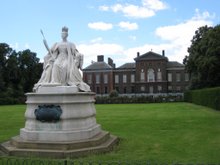
After Speaker’s Corner we walked quite a distance through the park to the Kensington Palace, which contains the State Apartments, home to the royal family for 900 years. The building was quite ordinary on the outside (we didn’t go in), of dark brick. However, the gardens were extravagant and even contained some huge metal flowers to commemorate the 10th anniversary of Princess Diana’s death.
Later we took the tube to Bond Street and turned southward to explore the Mayfair embassy district. The building here were quite unique and attractive—not just the embassies, but many of the others as well. The Qatar embassy was an old, red brick structure right on the street—reminiscent of an old school house.
Grovsnor Square includes several embassies, Canada, Italy and USA. The latter was encased in cement barricades and iron fencing. I don’t know if it is just construction or security measures, but it definitely changed the character of the area. Also there is a nice statue of FDR and a memorial to all those who died on 9/11.
##
Day 23
Hyde Park and Kensington Palace
Today is a rest day, no work and no extensive touring around the country—just an afternoon trip to Hyde Park, Kensington Palace and the Mayfair embassy district.
These parks are really impressive. We took the tube to Green Park, just north of Buckingham, then walked a short distance to Hyde Park. The Speaker’s Corner is around to the northwest side and we found it packed with people, many of whom were listening to speakers decked out in various forms of costume or props (flags, pirate outfits, blue jeans, house dress, etc.) One speaker said “…that’s what women really want, a man to put them in their place….” We left before the riot started!!! (just kidding!) Others talked about race, religion and various topics—often without anyone stopping to listen.
After Speaker’s Corner we walked quite a distance through the park to the Kensington Palace, which contains the State Apartments, home to the royal family for 900 years. The building was quite ordinary on the outside (we didn’t go in), of dark brick. However, the gardens were extravagant and even contained some huge metal flowers to commemorate the 10th anniversary of Princess Diana’s death.
Later we took the tube to Bond Street and turned southward to explore the Mayfair embassy district. The building here were quite unique and attractive—not just the embassies, but many of the others as well. The Qatar embassy was an old, red brick structure right on the street—reminiscent of an old school house.
Grovsnor Square includes several embassies, Canada, Italy and USA. The latter was encased in cement barricades and iron fencing. I don’t know if it is just construction or security measures, but it definitely changed the character of the area. Also there is a nice statue of FDR and a memorial to all those who died on 9/11.
##
Saturday, 21 July 2007
Little church near Rugby
20 July 2007
Day 21
Rugby:
Today we traveled to Rugby, about 1 ½ hours northwest by train to visit my cousin Hugh and his wife, May. We had a wonderful reunion and discussed all the family things that have occurred since our last visit 3 years ago.
After a wonderful lunch (beef burgundy, scalloped potatoes, fresh vegetables, trifle (for dessert), assorted cheese with grapes and wine!) we piled into the car for a tour of the area. It turned out to be cool and quite cloudy in Rugby, but we enjoyed exploring some of the back roads and even stopped at a little pub in Ashby St. Ledgers, a little village with thatched-roof homes, to stretch.
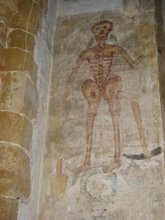
A local gentleman suggested that we check out the Norman-built church. When he said it was always open and contained some drawings “over 1000 years old” I was hooked! It turned out to be wonderful advice! I found a website below that describes the little church better than I ever could. However, we immediately felt a sense of intimacy with the heavy, moldy gate, the dark-thick door and the small group of pew boxes inside the sanctuary. Unlike many of the other elaborate cathedrals we previously toured, this one was modest but somehow comforting—almost as if it invited us to sit quietly and consider all that has taken place over the centuries since its beginnings. Truly, this was a treasure of a find!
http://www.ashby-st-ledgers-church.info/
Day 21
Rugby:
Today we traveled to Rugby, about 1 ½ hours northwest by train to visit my cousin Hugh and his wife, May. We had a wonderful reunion and discussed all the family things that have occurred since our last visit 3 years ago.
After a wonderful lunch (beef burgundy, scalloped potatoes, fresh vegetables, trifle (for dessert), assorted cheese with grapes and wine!) we piled into the car for a tour of the area. It turned out to be cool and quite cloudy in Rugby, but we enjoyed exploring some of the back roads and even stopped at a little pub in Ashby St. Ledgers, a little village with thatched-roof homes, to stretch.
A local gentleman suggested that we check out the Norman-built church. When he said it was always open and contained some drawings “over 1000 years old” I was hooked! It turned out to be wonderful advice! I found a website below that describes the little church better than I ever could. However, we immediately felt a sense of intimacy with the heavy, moldy gate, the dark-thick door and the small group of pew boxes inside the sanctuary. Unlike many of the other elaborate cathedrals we previously toured, this one was modest but somehow comforting—almost as if it invited us to sit quietly and consider all that has taken place over the centuries since its beginnings. Truly, this was a treasure of a find!
http://www.ashby-st-ledgers-church.info/
Side Trips
July 18-19
Couple of side trips
Greenwich:
I had a afternoon meeting on Thursday near London Bridge (close to our “dorm”; so Linda and I decided take advantage of the good weather and head out to Greenwich, a short tube or boat ride down-river from London.
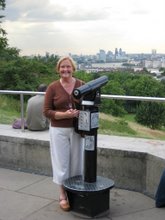
The Cutty Sark, the 19th century sailing vessel, was damaged and covered in plastic and scaffolding; so we dedicated to walk straight up to the Royal Observatory on the hill overlooking Greenwich town, the Naval College and far-off London.
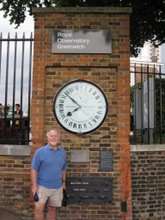
I never really thought about it too much—how we take for granted being able to find out where we are on the face of the earth. Now we have Google maps, GIS devices—even exquisitely detailed maps are a relatively recent invention. Apparently, latitude (the distance north or south of the equator) is easy to determine through celestial navigation. Longitude, the location east or west of some fixed location (like Greenwich) is more difficult—especially without an accurate clock. The time distance between London and NYC, for example, is 5 hours, representing 75 degrees of longitude or 15 degrees for each hour. Determining the time in a far-off ocean using the stars/sun/moon is not to hard, but knowing the time back home is much more difficult in an era of pendulum and stone weighted clocks that are affected by the temperature, humidity and movement of the ship across the water. It wasn’t until someone developed a reliable timepiece and until the Admirality established Greenwich as the “prime meridian” that navigators could accomplish both requirements of determining their location. Fascinating!
So Linda and I took turns straddling the prime meridian; then toured the observatory where observers sat and charted the heavens to establish accurate celestial maps for use in navigation. Hence, the British ascendancy as the “ruler of the seas”. I have a whole new appreciation for the self-taught watchmaker who solved the problem and made it possible.
It’s an interesting analogy for the public health profession. Knowing where we are takes a thorough knowledge of where we started (prime meridian) and what has happened in the interim—how long we have traveled. I think it is a case for evidence-based interventions and good evaluation—the first providing a reference point and the latter, a measurement/observation of the facts.
As an instance of irony to this analogy, Linda and I got on the wrong train for the return trip and arrived at London Bridge station without a ticket. The gate attendant was kind enough to listen to our sad story and let us through—his smile indicating that this was not the first time it has happened.
Broad Street Pump and British Portrait Museum
It poured rather vigorously on Friday morning; so Linda and I decided to stick close to home and explore some indoor attractions. Fortunately, the weather broke just long enough for us to fit in a visit to the Broad Street Pump, just north of Piccadilly Circus.
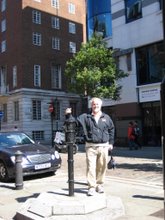
In 1853 cholera ravaged London. John Snow, a local physician, noticed that the people on Brewery St. (who drank the beer) did not suffer as greatly as those who lived on Broad (now Broadwick) street who drank from a local well. Without fully understanding the germ theory or the oral-fecal route of disease transmission from sewage in the water, he took the handle off the pump in an effort to quell the outbreak. Hence, the beginnings of modern epidemiology and the name of this blog.
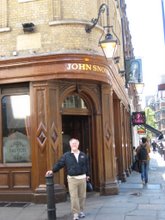
I have to admit that the pump, a rather inconspicuous metal affair in the middle of the sidewalk on a corner of the street, holds a fascination for me. John Tierney, our former Deputy Director and mentor to many of us, frequently referred to it and often accompanied his wife on flea market forays with the intent to find “the handle on the Broad Street pump.” He found a likeness, and it now hangs in the Director’s Conference Room with the story of John Snow. By the way, there is a John Snow Pub just across the street in case a devout public health professional want to “hoist a pint” in Snow’s honor!
National Portrait Gallery
From here we went to the Portrait Gallery for a quick tour. I can’t say that I am an admirer of classic art, but the extensive collection displayed portraits from the modern to those many centuries old. We recognized some of the more famous names (Churchill, Gladstone, Johnson, Burns, Montgomery, etc.). My favorite was the display of Princess Diana—a collection of formal and informal poses with some almost “tomboyish” renderings. What a loss!
We also marveled at several paintings of the Houses of Commons and Lords commemorating some important event. One wall-sized painting showed 259 individual faces, each one distinctive and fully-rendered, an undertaking of 10 years work by the artist. Remarkable!
The weather finally broke into a sunny, arid afternoon; so we decided to walk down by the Embankment along the Thames and toward our “dorm”. It was a beautiful walk, punctuated by statues, riverboats, panoramic scenes of the waterfront on the opposite side, and, of course, other people hurrying home from work or out for a stroll. We were surprised to find ourselves back in the neighborhood in so little time—a 4 mile distance as we later determined. So we were more than ready for dinner in the local pub.
Couple of side trips
Greenwich:
I had a afternoon meeting on Thursday near London Bridge (close to our “dorm”; so Linda and I decided take advantage of the good weather and head out to Greenwich, a short tube or boat ride down-river from London.
The Cutty Sark, the 19th century sailing vessel, was damaged and covered in plastic and scaffolding; so we dedicated to walk straight up to the Royal Observatory on the hill overlooking Greenwich town, the Naval College and far-off London.
I never really thought about it too much—how we take for granted being able to find out where we are on the face of the earth. Now we have Google maps, GIS devices—even exquisitely detailed maps are a relatively recent invention. Apparently, latitude (the distance north or south of the equator) is easy to determine through celestial navigation. Longitude, the location east or west of some fixed location (like Greenwich) is more difficult—especially without an accurate clock. The time distance between London and NYC, for example, is 5 hours, representing 75 degrees of longitude or 15 degrees for each hour. Determining the time in a far-off ocean using the stars/sun/moon is not to hard, but knowing the time back home is much more difficult in an era of pendulum and stone weighted clocks that are affected by the temperature, humidity and movement of the ship across the water. It wasn’t until someone developed a reliable timepiece and until the Admirality established Greenwich as the “prime meridian” that navigators could accomplish both requirements of determining their location. Fascinating!
So Linda and I took turns straddling the prime meridian; then toured the observatory where observers sat and charted the heavens to establish accurate celestial maps for use in navigation. Hence, the British ascendancy as the “ruler of the seas”. I have a whole new appreciation for the self-taught watchmaker who solved the problem and made it possible.
It’s an interesting analogy for the public health profession. Knowing where we are takes a thorough knowledge of where we started (prime meridian) and what has happened in the interim—how long we have traveled. I think it is a case for evidence-based interventions and good evaluation—the first providing a reference point and the latter, a measurement/observation of the facts.
As an instance of irony to this analogy, Linda and I got on the wrong train for the return trip and arrived at London Bridge station without a ticket. The gate attendant was kind enough to listen to our sad story and let us through—his smile indicating that this was not the first time it has happened.
Broad Street Pump and British Portrait Museum
It poured rather vigorously on Friday morning; so Linda and I decided to stick close to home and explore some indoor attractions. Fortunately, the weather broke just long enough for us to fit in a visit to the Broad Street Pump, just north of Piccadilly Circus.
In 1853 cholera ravaged London. John Snow, a local physician, noticed that the people on Brewery St. (who drank the beer) did not suffer as greatly as those who lived on Broad (now Broadwick) street who drank from a local well. Without fully understanding the germ theory or the oral-fecal route of disease transmission from sewage in the water, he took the handle off the pump in an effort to quell the outbreak. Hence, the beginnings of modern epidemiology and the name of this blog.
I have to admit that the pump, a rather inconspicuous metal affair in the middle of the sidewalk on a corner of the street, holds a fascination for me. John Tierney, our former Deputy Director and mentor to many of us, frequently referred to it and often accompanied his wife on flea market forays with the intent to find “the handle on the Broad Street pump.” He found a likeness, and it now hangs in the Director’s Conference Room with the story of John Snow. By the way, there is a John Snow Pub just across the street in case a devout public health professional want to “hoist a pint” in Snow’s honor!
National Portrait Gallery
From here we went to the Portrait Gallery for a quick tour. I can’t say that I am an admirer of classic art, but the extensive collection displayed portraits from the modern to those many centuries old. We recognized some of the more famous names (Churchill, Gladstone, Johnson, Burns, Montgomery, etc.). My favorite was the display of Princess Diana—a collection of formal and informal poses with some almost “tomboyish” renderings. What a loss!
We also marveled at several paintings of the Houses of Commons and Lords commemorating some important event. One wall-sized painting showed 259 individual faces, each one distinctive and fully-rendered, an undertaking of 10 years work by the artist. Remarkable!
The weather finally broke into a sunny, arid afternoon; so we decided to walk down by the Embankment along the Thames and toward our “dorm”. It was a beautiful walk, punctuated by statues, riverboats, panoramic scenes of the waterfront on the opposite side, and, of course, other people hurrying home from work or out for a stroll. We were surprised to find ourselves back in the neighborhood in so little time—a 4 mile distance as we later determined. So we were more than ready for dinner in the local pub.
Subscribe to:
Posts (Atom)